

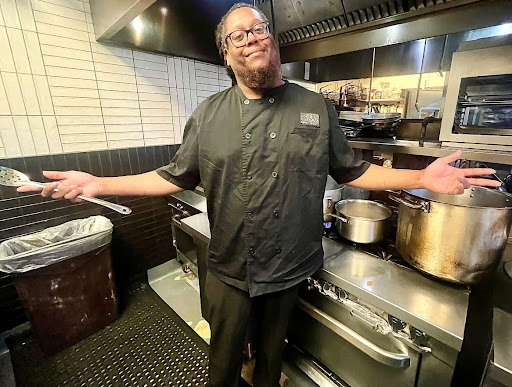
Quinnton Austin at Louisiana Purchase in North Park (By Frank Sabatini Jr.)
From New Orleans to San Diego: Chef Quinnton Austin Spotlights Black History Month; Shares Insightful Anecdotes About His Hometown
By Frank Sabatini Jr.
He is New Orleanian to the core, an accomplished chef who brings years of hard-working experience from his native Big Easy to San Diego. In addition, he’s an active supporter of other black chefs on the rise. As for his alligator cheesecake, well that’s another achievement altogether.
Quinnton Austin (a.k.a. Chef Q) is co-owner of Louisiana Purchase restaurant in North Park. He is also the culinary director for its locally based parent company, Grind & Prosper Hospitality, which operates Miss B’s Coconut Club in Pacific Beach, PRK101 in Carlsbad, and other restaurants and bars in San Diego County.
At Louisiana Purchase, he’s known for his palate-grabbing recipes that reflect various parishes throughout the Greater New Orleans area. When he isn’t slinging dishes such as braised oxtail and gumbo, the East Village resident stays busy promoting a network of Black chefs he helped form known as the Bad Boyz of Culinary.
We caught up with Chef Q just as he began planning ahead for February’s national Black History Month.
Downtown Condo Guys: What prompted you to move here from New Orleans?
Chef Q: I came to San Diego in 2018 for business opportunities—to market myself as well as to redo some of the menus that Grind & Prosper had in place with their brands. We then opened Louisiana Purchase in North Park, and I went in as a partner for it.
Downtown Condo Guys: Did you find the overall culture in San Diego to be much different compared to your hometown?
Chef Q: It felt extremely different. The first thing that stood out is that I didn’t get the sense that Black people’s voices here were very strong, or that they mattered. New Orleans is built by Black people—Africans, Haitians, Caribbeans, and American blacks. And all of their chefs hang with each other. Here, it wasn’t so much a brotherhood. Even the whole spirituality of San Diego felt different. Although I feel like it’s gotten better, maybe because I personally built a hub for my own community by reaching out to Black chefs locally and nationally and starting the non-profit organization, badboyzofculinary.org.
Downtown Condo Guys: How does the organization assist Black chefs?
Chef Q: We help Black chefs get jobs, sponsorships and training. And we raise funds for scholarships. We try to do all of that.
Downtown Condo Guys: When in your life did you take an interest in cooking? And what are your culinary specialties?
Chef Q: The main sources of income in New Orleans are hospital, correctional and hospitality. Everyone’s first job goes through one of those three. I started cooking as my first job—at the age of 18. But I didn’t begin taking it seriously until after Hurricane Katrina hit. That was when I was moving around Louisiana and cooking for all the displaced people for about six months. The only equipment we had were two George Foreman Grills and two hot plates. But we cooked steaks, spaghetti, shrimp Alfredo, fish and everything for everyone.
After returning to New Orleans, I went to The Culinary Institute of New Orleans for my two-year certification. I then started working for as many different restaurants as possible all over Louisiana to learn different cuisines. I was told by another chef to never let people put you into a box.
Downtown Condo Guys: Was there anyone in particular who inspired you to pursue culinary?
Chef Q: As far as pushing me to be a chef, it was my dad and a culinary instructor at the institute known as “Chef Charlie.”
Downtown Condo Guys: Was it difficult establishing yourself as a chef in New Orleans?
Chef Q: Chef certification from culinary school in New Orleans doesn’t mean shit because it really all depends how you come up through the ranks. The kitchens down there have 20 to 30 line cooks, and everyone wants to be a chef. It’s hyper-competitive.
Downtown Condo Guys: What are your top-selling dishes at Louisiana Purchase? And tell us about your alligator cheesecake.
Chef Q: Lemon-pepper catfish, gumbo, our fried chicken plate, and braised oxtail, which is the most recent addition to our menu. My food doesn’t reflect the touristy dishes of the French Quarter, although they got me with the beignets, which they forced me to put on the menu [chuckle]. Otherwise I represent foods from the parishes of New Orleans.
My alligator cheesecake also sells well. We’ve had it on the menu from the beginning. It’s made with alligator tail meat from Louisiana, andouille sausage, smoked Gouda, peppers, onions and garlic. We finish it off with crawfish cream sauce. It’s my version of the one served in Jacques-Imo Cafe in New Orleans.
Downtown Condo Guys: Will you celebrate Black History Month in any way at Louisiana Purchase?
Chef Q: Yes. I always do Black history lessons at the restaurant through our specials. I’ll do about four different dishes in February named after different people and monuments. I write all of their summaries, which are printed on the menu. I still haven’t decided yet on this year’s names and places.
Downtown Condo Guys: What Black leaders from the past or present do you admire most?
Chef Q: I’ve always looked up to Marcus Garvey because his stance was a little different than King or Malcom X. In many ways he believed that if you don’t like another group, just leave them be. In his perfect world, everyone would just go back to their own communities and not bother other groups they don’t like. I learned about him back in middle school.
I’ve also always liked Leona Tate, who was a pioneer of the Civil Rights movement, and chef Leah Chase, who is the queen of Creole cooking.
Downtown Condo Guys: Compared to, let’s say 25 years ago, is the culinary industry today more embracing of Black chefs?
Chef Q: Not really. Racial barriers still exist, and there aren’t enough Black chefs. Stuff like that happens in New Orleans too, where the whole kitchen staff is black and they bring in a white executive chef from Iowa. It just doesn’t make sense.
Downtown Condo Guys: What advice would you give to young, aspiring Black chefs for becoming successful?
Chef Q: It would be the same advice that was given to me: Learn how to cook as many different types of cuisines as possible so they can never put you in a bubble. Always be yourself. Don’t back down and don’t be afraid to be yourself. There will always be groups of people that rally for you, especially on today’s social media platforms.

